
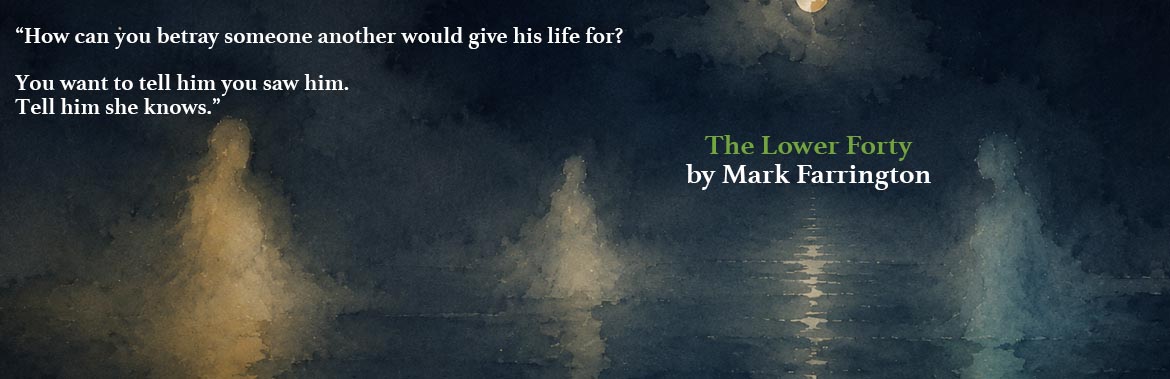
Read More: A Q&A with Mark Farrington
You hoped the summer before senior year would be uneventful, but your father ruined it by running off with a twenty-three-year-old to an artists’ colony in New Mexico. Your father isn’t even an artist. The twenty-three-year-old makes Native American jewelry, but you glimpsed her once, waiting beside your father’s car: blonde hair falling to her waist, blue eyes and rosy cheeks—hardly an Indian look.
These thoughts you keep to yourself, driving through the grey dawn to your first day of summer work, the newest member of the maintenance staff at a high-class inn. In the passenger seat, your mother nods her head as if she’s having trouble staying awake. At home she’d tugged on her jeans, the loose ones with the accordion waist, right over her pajama bottoms, which now poke out around her ankles and make her look like she’s wearing a diaper. After dropping you off, she’ll need to drive the fifteen miles back home, where she’ll begin getting ready for her own job, which fortunately doesn’t start until nine.
The inn owns two hundred acres on one side of a two-mile stretch of road. You drive past the stone pillars marking the front entrance, turn onto a dirt road disappearing into woods. Eventually those woods draw back, leaving you amid vast lawns at the bottom of a hill. You pull into a corner spot, where employees are allowed to park.
“Are you sure you’ve got everything?” your mother asks, and you say, “Yeah,” in a tone that suggests you’re old enough to neither need nor want her to ask, but then you soften when she says, “I’ll pick you up at six.”
“Thanks. Have a good day at work.”
“You too,” she says, looking proud. You’ve been mowing lawns every summer since sixth grade, but this is a real job, working around the public, and what a public it will be: movie stars, artists, musicians, and some of the richest corporate people in the country all come here for their summer stay in the beautiful Berkshires.
You wince at the rattling metal and exhaust fumes as your mother backs the car out and drives away. You’ve been warned about noise: no lawnmowers until 10 a.m.
The main house—the Relais Chateaux Inn, built to resemble a Scottish castle, with its tennis courts and croquet lawn and rooms that rent for up to two thousand dollars a night—sits at the top of the hill, but from your vantage point at the bottom, you can’t even see the castle’s spires reaching into the sky. Your instructions restrict you to this lower area, where there’s a fancy, motel-like structure named “The Carriage House” (rooms as “low” as $500 a night), a small, two-story wooden building called “The Potting Shed” that contains a sauna and a hot tub, with a swimming pool outside, and all of it surrounded by lots and lots of lawn. Back in the woods, mostly hidden by foliage, sits an old garage where the maintenance staff stores the tools. You walk toward that garage now, hoping to find Frank, your supervisor, the head of buildings and grounds.
The garage is padlocked, no one around. “I may have stuff to take care of in the morning,” Frank told you when you came in for training on Friday. “If I’m not here, start without me.”
You’ve been hired to work eight to six, four days a week, but you have to be here by seven because your mother needs the car. You thought you might nap away that extra hour, but you’re anxious to get started, so you begin clearing broken branches from the edge where lawn meets woods. The owners, Frank explained, want the lawn to look like a beach flowing naturally into an ocean of woodland.

In the afternoon you’re on your knees clipping grass by hand around the Potting Shed while one of the guests lounges by the pool. A couple hours after you arrived, Frank showed up to unlock the garage, but you haven’t seen him since. You’ve spent the last four hours mowing, and although clipping grass like this is tedious,—the managers forbid gas and electric trimmers—you welcome the chance to get off your feet.
The guest by the pool with a lean, tan body and hair a mix of gold, brown and red has got you composing a poem in your head about wheat fields and sunsets.
Currently she’s lying on her stomach. She wears a dark-blue swimsuit, two piece but covering everything, no lumps or lines or creases sticking out from what should be private places. You know she’s rich by the confidence she exudes and by her perfect skin, even though she’s wearing no jewelry other than small earrings. The diamond rings and bracelets she must have left back in her room.
When it becomes too hard not to look at her, you turn your back and re-focus on the work. It’s hot, and continually squeezing the clippers makes your sweaty right hand cramp, but you don’t have enough dexterity in the left to switch for long. You’re thinking of going back to mowing when you feel something nearing, like a cloud crossing the sun.
“You look thirsty.”
You scramble to your feet. “I’m sorry, ma’am,” you huff, wince at the word “ma’am,” like she’s an Old West schoolmarm, then accidentally look into her eyes. They’re gunmetal-green, like a roiling ocean, thrilling and dangerous. You lower your head. “I didn’t mean to bother you. I’ll go work over there,” you say, gesturing vaguely.
“You’re not bothering me,” she says. “I just thought you might be thirsty.”
When you dare look up again, she seems amused. You’re too conscious of the patches of sweat soaking your uniform shirt, and the flecks of mowed grass stuck to your slippery neck.
“Wait here,” she says, “I’ll be right back.”
She disappears into the Potting Shed. She’s gone long enough to make you antsy; you never know who might be watching. Fraternizing with guests is another thing forbidden. If a guest asks for something, you tell them, “Yes, right away,” and run off to get it, or find someone who can. Otherwise you act invisible.
She returns wrapped in a white bathrobe and carrying a tall glass of water with ice cubes clinking inside. Realizing you’re still holding the grass clipper, you switch it to your left hand, but as you reach out, your right hand cramps again, and you lay the clippers on the ground and accept the glass with both hands clutching tight. Drinking, you imagine the icy water tumbling over you like a waterfall.
You’d down the whole glass, but you stop when drops dribble down your chin. Still wary of your cramping hand, you steady the glass against your chest to wipe your mouth.
“See, I was right. You were thirsty.”
You thank her, and she extends a hand—to take the glass, or shake yours? The latter, you discover, without embarrassing yourself too much.
“I’m Barbara,” she says, as you lay your hand in hers, letting her decide how tightly to grasp it. You just say, “Thanks” again, which forces her to ask, “You are?”
“Danny,” you tell her. “I just started work today”—your excuse for missteps big and small.
“I live up there with Richard.” She gestures toward a window in what must be an apartment on the second floor of the Potting Shed. “I waitress mostly, fill in where I’m needed. Richard’s the sommelier, technically, but he runs things in the kitchen. Matthew’s a great chef, but his organizational skills are zero.”
“You’re not…”
She laughs. “A guest? Don’t I wish.” Then she shakes her head. “Check that. If I had the money to stay here, I’d go to the Bahamas instead. Or Nova Scotia. I’d trade this place in a heartbeat for a cabin on the Bay of Fundy.”
“This is my first day,” you say.
That raises an amused smile. “You work for Frank.” She peers into the distance. “Where is the little troll?”
This brings a smile. Frank is short and fat. He’s told you to make up an excuse if anyone asks for him, swear he’s off doing something important, but you don’t feel like lying to this woman. “I’m not sure,” you say.
She nods knowingly. “Frank’s okay. Though if he put as much effort into working that he puts into figuring out ways to avoid working, this place would run like clockwork.”
You smile because it’s safer than words.
“Well,” she says, and holds out her hand for the glass. “You’ll have to come up sometime, meet Richard. Maybe we’ll all have lunch together.”
“That would be great,” you say, and you mean it. Then, as she’s about to walk away, “I’m sorry I interrupted your swimming.”
“I was just lounging. We’re allowed to lie around the pool, use the hot tub and sauna, as long as we don’t get in the guests’ way.” She pauses, thinking. “You’re probably not here at night?”
“I work until six.”
“You live nearby?”
You shake your head.
“That’s too bad. There’s nothing better, at the end of a shift, than peeling off your sweaty uniform and climbing into that hot tub. Of course, it’s usually two in the morning when we finish and all the guests have gone to bed. But if you’re ever out and about at that time, come on by.”
“I will,” you promise, knowing there’s no chance of that happening, and there’s nothing you’d rather do.
“See you,” she says and disappears into the Potting Shed. You step back, gaze up at the second-floor window, prepare to wave should she appear, looking down. But all you see is the reflection of trees and sky.

Frank and the two other members of his crew, whom he’s known since grade school, ride around in the company truck and take care of everything at the main house, leaving you confined to what you call “the lower forty.” But that’s all right. There are rich people staying in the Carriage House, Mercedes and Jaguars and even a Lamborghini in the lower parking lot, and rules employees must follow, but nothing like the pressure of working in the main house, where the slightest faux pas could get you fired. Or so you imagine.
A week passes and you haven’t seen Barbara again. Then you’re out sweeping the cut grass off the stone walkway in front of the Carriage House (since the manager doesn’t allow blowers either), when an old Volvo station wagon, burnt red and scarred with rust, pulls into the employee parking lot at the edge of the woods. When Barbara lifts grocery bags from the back, you rush over.
“Do you want some help?” you ask.
She sets the bags down. “It’s you. Hello.”
You hear in her tone, Happy to see you.
“I can help you carry this. I owe you a favor.” To her puzzled look you explain, “That day you gave me water.”
“Ah,” she says, and hands you a grocery bag, then a second. You ask for a third, but she says, “I’ll have to make another trip anyway,” and you smile; your time with her has just doubled. You finished mowing an hour ago in a cooling breeze, so you’re not drenched in sweat as usual. Even though all that previous sweating probably left a smell.
Her smell reminds you of honey as you walk with her across the lawn. “You must start early,” she says, perhaps inhaling the fresh scent of the grass.
“I’m here by seven.” You hope she doesn’t ask more. You don’t want to admit your mother drives you to work.
Inside the Potting Shed, across from the hot tub, stairs lead up. You motion for her to go first, to be polite, not realizing that when you follow, your face will come close to her jean-clad rear. All week, when you wondered about her age, you were content with a vague comparison: older than you, younger than your mother. Suddenly it matters where in that range she might fall.
You halt as she searches for her key. “It’s a little unnerving sometimes,” she says. “People come up these stairs, try to open the door. Some of them keep jiggling the doorknob, even though it’s obviously locked. Like, how dare we lock them out of somewhere they want to go? It creeps me out, especially when I’m alone. You know?” she adds, with a look that wants you to.
“I do,” you swear.
When the door opens, you follow her into a single giant room, a queen-sized bed in the center, blankets and sheet strewn about. “You can put them here,” she says, and you break your fascination with the matching indentations in the pillows and move to a kitchen table in one corner. There’s a sink and a refrigerator and a stove, all old, crammed against the wall.
Barbara’s holding an open palm against her lungs. “I’ve definitely been smoking too much this summer,” she says.
“I can get the rest myself,” you offer. “You don’t have to make another trip.”
“Oh, would you? You’re so sweet.” Her eyes light up in surprise and gratitude, even as you sense she’s known all along you’d offer.
When you return, she’s sitting in a wicker chair beside the bed, sideways so her legs dangle over one armrest. You smell the smoke before you notice the cigarette held between two fingers. On a table at the foot of the bed there’s a small television with aluminum foil wrapped around the antenna tips, showing a snowy picture with no sound.
“I must be getting old,” she says. “I think I need a nap.”
She does look pale, ashen even, with shadows beneath her eyes. You tell yourself she probably just had a late night, but it’s not hard to dream up a Hollywood fantasy: tragic young woman fighting a debilitating disease.
If it were true, you’d welcome the chance to help her.
“Well,” you say, “I should get back to work.”
“I could offer you ice water. We have orange juice. There might be a can of soda somewhere. I know we have beer, if you want one.”
“I’m good, thanks.”
“You saved me a couple of trips.”
You grin. “I liked it.” The words are out before you can think how stupid they sound, followed by a laugh that sounds to you like the braying of a mule. “Sorry,” you mutter, but you can’t stop your gaze from returning to that unmade bed. You force yourself to find her eyes, then quickly drop your head. “Well,” you say, and turn, concentrating hard: grip the doorknob, open the door, pass through and close it gently behind. Don’t trip going down the stairs, don’t knock into walls. Don’t make more of an ass of yourself than you already have.
Resting in the shade, eyes closed, a voice saying “I hear you’ve been visiting my wife’s bedroom” makes you scramble. Facing you is a man dressed as if he just walked away from a British boarding school in the years before World War I. White shorts and a white shirt under a pullover sweater vest, white with slanted rows of big blue diamonds that match his knee socks.
On top of his head sits a tangle of curls that could be home to a pair of nesting birds. These curls, and a pencil mustache, make his outfit seem like a costume.
“Richard Germaine.” His soft hand wraps around yours easily, without ego.
His bright, quick eyes warn of a prankster. “Seriously, thanks for helping Barbara out the other day.” Then the grin, a playful tap on the shoulder. “Had you going, didn’t I?”
“She helped me out,” you say, more defensive than you ought to sound. “My first day. She gave me a drink of water.”
“Countless love affairs throughout history have begun because a fair damsel offered a downtrodden hero a drink of water,” Richard says, then peers at you. “Are you a downtrodden hero?”
“I just mow the lawn,” you say, and he erupts in laughter, clapping you on the back.
“Barbara said I’d like you.” His laughter turns into a coughing fit that forces him to twist away, hawking up phlegm he spits into a clump of bushes.
“Sorry.” He wipes away tears. “All winter long, I don’t smoke a thing—not tobacco, anyway. Then it’s back here, and Barbara and I both light up like chimneys.”
He sighs. “I’m glad we had a chance to meet. You’ll have to stop by the apartment some time. We’ll have you for lunch.”
He studies you, testing to see if you’ve caught the ambiguity, that he could be inviting you to be a guest, or the main course. His grin says you passed.
“Have to run. I’m off to teach Mrs. Beatrice Perriwinkle-Teasdale the subtleties of croquet.” His voice slips into a snobby British accent, as you wonder if there could really be someone named Mrs. Beatrice Perriwinkle-Teasdale. “Cheerio!”
Suddenly, you have two friends, who know nothing about you, your mother or your past. Who see you as if you’d been born that first day of summer work. And like what they see.
You watch for them while you work. The anticipation makes you feel like a child again, hurriedly dressing so you can rush out to play in fresh snow. Even a glimpse of Barbara thrills you, as she waves while walking up to the main house dressed in her server’s uniform, long black dress with a white apron, that makes you think of pilgrims’ clothes.
Sometimes she invites you to come up and talk. At her urging, you speak of dreams and desires, how for as long as you can remember, you’ve been yearning to taste the world beyond these confining hills. “College will be my salvation,” you say.
“I went to college for a year.” She shrugs. “It never worked for me. Me being a college graduate was somebody else’s dream.”
You hear yourself reply, “It’s not that big a deal to me. What matters is getting away.”
During these talks, she usually sits in the wicker chair sideways, her legs draped over one armrest. She wears shorts or a loose summer dress, and you know you should corral your gaze that wants to glide up and down her tan legs. But when you fail and she notices, she seems not to mind.
She and Richard will be heading to Greece, she says, once the season ends. Last winter they lived in a fishing village off the coast of Portugal. “It’s a quiet life. Lots of good food, good people, no pressure. You feel free.” She pauses to light a cigarette. “We go someplace different every winter. We live off what we save from the summer, and if we run short, good restaurants can always use someone who knows wine, and they always need waitresses.”
You’re still searching for a way to sneak out of the house late at night and join Barbara and Richard in the hot tub, after the guests have gone to sleep. You’ve dreamed up a few passable lies, but Barbara and Richard are subject to the whims of the guests. July is the summer’s busiest month, and the noise underneath has kept them awake until three or four a.m. some nights, Barbara says.
One day Richard invites you upstairs in the late afternoon. He’s excited, and excitement from either one of them, Richard or Barbara, is contagious. “Look who I dragged in from the alley,” Richard says to Barbara, who pops out of her chair and grins. “I figured it was time to end his virginity.”
You grin foolishly, praying that the thought racing through your mind doesn’t show on your face. Richard has arranged three chairs around the table and placed an empty wine glass at each spot. Holding up a half-empty bottle of wine, he says, “You may have drunk wine before, but I promise you, nothing like this. This is something you’ll remember your whole life.”
He reads a name, then says something your two years of high school French can’t translate. He pours a sip’s worth into each glass. “This bottle,” he says, cradling the wine like he would a baby or a plaque, “sells for one thousand eight hundred dollars. A movie producer ordered it for him and his lady friend. They each had one glass and left the rest of the bottle, so naturally, I helped myself.”
At first you can’t believe the price, even though you’ve seen the opulence all summer, even stuck in your lower forty. You conclude Richard’s virginity comment must have to do with this wine, and you try not to look disappointed.
Richard raises his glass. You watch but don’t follow suit until Barbara joins the toast. Richard spits out some word that might be “Cheers” in Greek, and then the three of you drink. You haven’t had much wine in your life, but you figure what you’ve had never cost more than five dollars a bottle. This is clearly better—satiny smooth—but no trumpets sound, no fireworks explode.
When they both look to you for a pronouncement, you don a sly smile and say, “It’s better than what I’m used to, sure, but is it seventeen hundred and ninety-five dollars better?” They erupt in laughter, and Barbara, leaning in from the side, hugs you close.
Later, Richard rolls a joint. He keeps the stuff in a plastic bag in a kitchen cabinet, among the cups and glasses. You’ve smoked dope before but not often, and nothing that hits you as hard as this. It’s like your mind—just your mind—has been drawn out of your head and placed on a towel in the sand where ocean waves flutter in, seagulls squawk overhead, and a raspberry haze coats the horizon.
Eventually Richard gets up and lays out his tuxedo for dinner. Somehow you’ve ended up sitting in Richard’s chair, facing Barbara stretched out on the bed. “He must have gone to Eton or Cambridge or something,” you say, gesturing toward Richard and raising your eyebrows. Barbara smiles. “Cal State San Luis Obispo is more like it.” She calls out, “Dickie?”
Through the open bathroom doorway comes, “Yes, Barbie.”
“Where’d you go to college again?”
He appears, only a towel around his waist, shaving cream coating his chin. “You want alphabetical? Geographical? Chronological?”
“Whatever.”
“Okay, let’s see. There was Cal State San Diego, Long Beach State. Cal State Northridge, Santa Barbara, Fresno.”
“What about San Luis Obispo?”
“I missed that one.”
“No,” she says, as shocked as if she’s missed a Final Jeopardy question based on her own biography.
“For a while I thought I might become a professional student. You can do that in California, move around. It’s a great way to tour the state.”
“I can’t believe you never went to San Luis Obispo.”
Plodding back into the bathroom, he calls over his shoulder, “Maybe I’ll go back sometime.”
“Why’d he do it?” you ask when he’s gone. “Go to all those schools?”
“He liked being a student. Not going to class so much, although he’s smart, so he never had to work hard. He liked the freedom, the lack of responsibility. Room and board provided, you only need to come up with enough cash to buy weed and fund the 2 a.m. excursions to Jack-in-the-Box. College for him was like a never-ending vacation.”
“Tell him where you went to college, Barbie” came Richard’s voice, snaking out from the bathroom.
She shoots a loathsome look in his direction, then looks at you, resigned. “All right, I admit it. I went to Bryn Mawr. It’s true, my family is old aristocracy. You know the kind—that used to have money and culture, until the money got used up, and now even the culture is eroding, one chipped china teacup at a time. The Winton family has responsibilities,” she says in a deep, pompous voice. “Fortunately, I have two brothers and a sister who bought into all that crap, so I don’t have to. Besides, every family needs a black sheep.”
“Little Barbie was a rebel,” says Richard, coming out partially dressed. “She engineered a jailbreak, jumped the fence.” As he leans across the bed, Barbara sits up, and they kiss.
Later, after Richard goes off to finish dressing, Barbara says, “I wasn’t really in jail,” and although you assumed that, her words bring relief. “But everyone’s a prisoner, if you think about it. So many people around the world are prisoners to their own need for survival, but even these people”—she gestures toward the window—“the rich are prisoners to their money, their desires, their acquisitions. And those of us in between, we’re trapped by hopes and dreams and responsibilities, by all the things we feel we should or shouldn’t do. Richard and I have tried to free ourselves of all that. Sure, we work here four months out of the year, but the rest of the time, we’re free to live however we want, wherever we want. What better life than that could there be?”
A voice in your head wants to argue. What about the future? A family? A home? What about when you’re older and you look back, what will your life have accomplished? You’re not sure if these questions are yours or your mother’s, but either way, you don’t want Barbara to hear you say them.
When Richard reappears, Barbara stretches and yawns.“ Sweetie,” she pleads, “you think you could get somebody to take my shift tonight? I’m wiped.”
At the mirror fixing his bow tie, he shrugs. “Sheila’s probably still around from lunch. I can ask her.”
“Would you? I really need a night just to veg.”
“I’ll ask. She’s always looking for more hours.”
For a moment the fantasy tickles your brain: you’ll stay and she’ll stay and you’ll be here together. Then you remember where and what time it is, you remember your mother who always arrives at six sharp and sits on the side of the road because she doesn’t feel right driving onto the property. You jerk upright in your chair as if you’ve been sleeping and look at your watch. It’s five to six.
“I have to go too,” you say, already reining in your wild-running mind, picturing the mower and all the scattered tools you have to collect and return to the shed. You thank them both, wish them a good night, and hurry down the stairs, while in your mind, it’s Richard leaving, Barbara scooting over and patting the mattress for you to hop in. Nothing too outrageous ensues; you lie together eating popcorn and watching movies, and maybe later she grows sleepy and rests herself in your arms.
At home you eat dinner with your mother. You’re grateful for the TV that protects against silence. Fortunately you have tidbits from the resort to share: Martha Graham in the Queen Palace Suite waking one morning to a mouse eyeing her from the pillow next to her head, Barbra Streisand dining in a private luncheon room, accosted by a patron who barged in demanding an autograph.
Richard’s the main supplier of these stories you share with your mother, while Barbara tells stories you keep to yourself, like the time she walked in on a corporate executive who had sent his wife on a shopping spree so he could have sex in his room with his driver, a barely-legal Latino man.
These stories—the ones you share—seem to reassure your mother there’s still order to the world, despite your father’s behavior. You haven’t seen her cry, not once all summer. Mostly she acts as if nothing’s changed. She reminds you to decide which colleges you want to visit in the fall so she can put in for days off from work. She keeps tabs on how the Red Sox are doing and asks how your high school football team will fare this fall.
A few times, your father has telephoned. You let her answer, and when she draws the kitchen chair away from the table and sits, her body curled up facing the wall, you leave the house. Although tired from being on your feet all day, you walk a long time, sometimes as far as the bridge two miles from your house. It’s not only that you don’t want to talk to him. You don’t want to deal with your mother right after he’s ripped off the scabs she’s hardened.
Sometimes you get a crazy thought: what if you quit school, quit everything, and went off to Greece with Richard and Barbara? You’ve dreamed of going to college since before you can remember, but do you even know why? Wasn’t it always just the required path laid out for you, like when you finished eighth grade and automatically moved into ninth, never stopping to ask, Is this what I want? Do I have another choice? Over the years you’ve saved $10,000 for college; you could live a long time on that. And there must be grass somewhere in Greece for you to mow.
It eats at you. You have never, you think, truly lived in the moment. Even away from work, you’ve lived as if plodding behind a mower, keeping a straight line, sedating your mind with vague dreams of a future whose only certainty is “not here.” Imagining yourself at college is harder than picturing yourself sitting with Richard and Barbara on a stone porch of a fishing village looking out at the incoming tide tickling your front yard. Drinking sangria, you think, although you’re not sure what sangria is, exactly.
The problem is your mother. Quitting school and running off with Richard and Barbara would be the worst kind of abandonment. It would truly make you your father’s son.
August comes too quickly: in ten days you’ll be starting two-a-day football practices and a week later, school. Richard and Barbara announce that on your last day, they’ll take you for a picnic at a lake a few miles from the inn.
One morning, earlier than usual because your mother has an early meeting, you pull to the side of the road beyond the back entrance, grab your lunch, nod when she wishes you a good day, and walk away from the creaks and groans of the car retreating.
A waist-high fog hovers above the lawn. You’ve come to like this early morning time, before the sun has taken control. There’s a red fox that sometimes follows you and a family of turkeys that scamper when they see you, the mother herding the chicks into bushes, then taking off in the opposite direction, hoping to draw you away.
The sky is clear and blanched of color. There’ll be nothing but mowing today because Barbara is away visiting friends. The resort feels plainer, more mundane without her, but less pressured too.
You circle around the Carriage House, then halt at a noise: someone coming out of the Potting Shed. A guest, you assume, out for an early dip in the hot tub.
It’s a woman, tall, with dark hair. A plain face. She’s wearing jeans and a tee-shirt, cradling a bundle of clothes in her arms, black with some white. A waitress’s uniform. You recognize her then, from the trips she’s made delivering room service to Carriage House guests. Sheila.
She gets into a battered white car parked among other employee cars. It spits out exhaust starting up, crunches gravel. You peer up at the second floor window, where Richard stands, shirtless, looking out, then down, at you.
“I don’t know when I’ll be home,” you tell your mother on the morning of your last day. “Late, probably. Don’t worry about me.”
You’ve made up a story about a staff party; yes, you can get a ride home; yes, you’ll make sure the driver hasn’t been drinking. You’ve made up other embellishments your mother doesn’t ask for. […]
Subscribers can read the full version by logging in. |
Mark Farrington recently retired after nearly forty years of teaching writing, the last twenty-five of them in the MA in Writing Program at Johns Hopkins University. He has published short stories in Carve, Craft Literary, The Louisville Review, and other journals. His short fiction has won the Editor’s Choice Award in the Raymond Carver Fiction Contest, the Dan Rudy Fiction Prize, second prize in the Dame Alice Throckmorton Fiction Prize, two honorable mentions for the Momaya Prize, and an Individual Artists Grant from the Virginia Commission on the Arts. He is a four-time winner of the Outstanding Faculty Award in the Johns Hopkins MA in Writing Program. He grew up in the Berkshires in western Massachusetts, earned his B.A. from Colby College, and completed his M.F.A. in Fiction Writing from George Mason University. Farrington and his wife Christina have recently moved to Maine after living for more than thirty years just outside Washington, D.C. His first novel, Loss of Life, will be available from Legacy Books in Spring 2026.
“The Lower Forty” was originally published in The Valparaiso Fiction Review.
Read More: A Q&A with Mark Farrington