
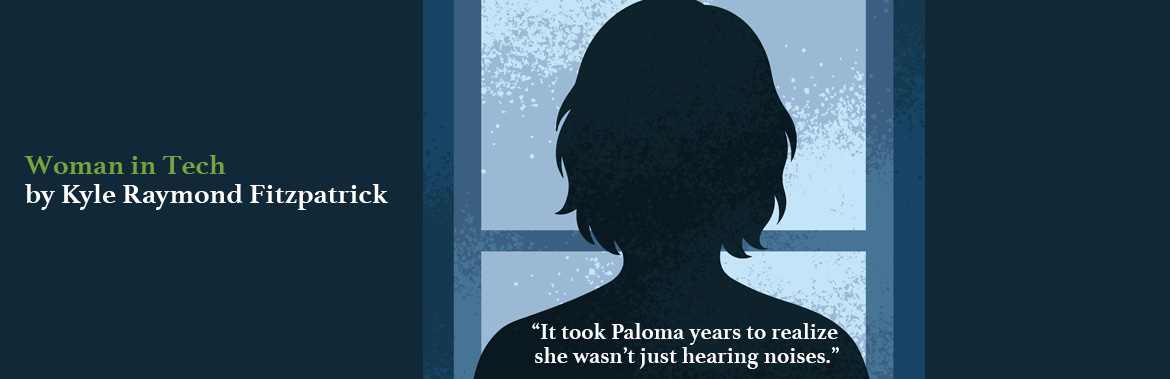
It took Paloma years to realize she wasn’t just hearing noises.
She lived on the top floor of a brick townhouse in San Francisco, a charming Victorian covered in glossy, scaling ivy that made the structure appear to vibrate when the wind blew. It was on a hilltop, settled among similar houses, but had a sensibility that made it unique. White painted bricks, an ultramarine door, silver hardware that twinkled in the sunlight: all the effects of a future looking eye applied to a form of the past. It was like a grandmother who had a way with emerging trends.
Her unit was on the fourth floor, which was annoying when she was returning from a long trip or after too many glasses of wine, but the problem of stairs was ameliorated by vintage features that actually worked. Pipes squeaked, some doors wobbled, but it was all original – and she loved that. All the things that mattered – the showerhead, the refrigerator, the ceiling fan – were new, tastefully considered to avoid the cold sleekness or nostalgic ornamentation of contemporary design. They fit in without standing out. She felt the same way: this was her place and, while this wasn’t her style, she felt welcome, at home. There was occasionally a burnt electrical smell and the summers could be unbearably hot — but it was hot everywhere in the summer. Plus, she was close to the sky. The heat made sense to her.
The noises were small at first and didn’t even register as noises: a creaking floorboard, a doorknob turning, a tapping on the window. Wind? It was wind! The house settling. Construction down the street! It’s an old ass house. There were so many covers for the noises, which were and weren’t the reason for the noise.
But the noises evolved, becoming more clear, to the point where Paloma couldn’t describe them as “noises”: they were words said just above a whisper. She would be washing dishes, given the apartment didn’t have a dishwasher, and hear someone compliment her. “So pretty,” someone said. She turned off the water, looking around. The voice was delicate, a breath that had run up from the street below to settle on her shoulder. She dried her hands and walked into the living room: the television was on, but it was the livestream of a mother bird she liked to put on as she read emails before bed. It was on mute too. Maybe it was a neighbor? She walked to the window, looking down to the sidewalk: no one. She returned to the dishes, to her task, and didn’t hear anything else.
Weeks later, she awoke to a voice. “Alone,” someone said. “Asleep.” This voice was hoarse but nearby, spoken from a corner of the room, by the cracked door. She sat up, looking around. Was someone talking to her? It was sunny and the windows were closed. She gulped and looked under her bed: no one. “Hello?” she asked, voice dry, a sonic reflection of what she heard. Nothing. Had she spoken to herself? She put on socks, grabbed the bat she tucked behind her bedframe, and looked in the closet: nothing. Maybe it was her phone? Birds chirped. Maybe it was them? There was a raven on a branch, a big black bird whose gaze was focused downward. She had seen videos of ravens speaking since ravens – like parrots – were master mimickers if given the right attention. That bird, she thought. That bird learned to speak.
But it wasn’t a bird, this she was sure of, when a voice said something so clearly directed at her: “Boring.” This voice was clear, feminine, young. She jumped up from the puzzle she was doing at her coffee table, arms in front of her, hands in fists, body bowed, ready to fight not fly. “Who’s there?” she barked, looking around. It was nighttime, her apartment glowing with lamplight on this Saturday evening. The television was on, playing a movie about a race of people who lived in the trees of a distant planet. The volume was low, barely audible. She leaned toward the remote control at the puzzle’s edge and turned the sound off. “I know you’re here,” she said and cleared her throat. She stomped around, making herself bigger. “You called me boring.” She grabbed a chair, holding it in front of her. She was going to get whoever it was. Maybe someone lived in the walls? She heard something about that on the radio. Or was it a ghost? She opened every door – bathroom, front door, pantry, closet one, closet two, bedroom, bedroom closet – before opening a few cabinets and cupboards. No one was there. Obviously no one was there! She put the chair back at the table and wandered back to her puzzle. The television showed the people who lived in the trees leaping from branch to branch with the help of their tails. Aliens? Maybe it was aliens. She lowered herself to back to the coffee table. Something was going on, even if it was only an elevated nothing.
She told a few friends about the voices, mentioning that the strangest thing was happening: someone was in her apartment whispering words at her. “You need a roommate,” a co-worker told her at happy hour. “You gotta get laid,” a girl from pilates told her. “Your vocal fry is rotting your brain,” a friend jabbed over text. “But it’s for sure a ghost. I’ve been to your place and it’s absolutely haunted.”
Paloma thought they were being dramatic but they all had the same idea: she spent too much time working and too much time alone. Her imagination had ballooned, threatening paranoia. Was she experiencing psychosis brought on by a lack of socialization? Who knew. Friends said she should move — but where would she find another townhouse? And brick. Rent controlled! In San Francisco? There wasn’t anything better. All those people could fuck off, Paloma said to herself anytime she thought she heard a voice.

A picture fell and someone squealed.
Paloma looked up from her computer, peeking from her hunch to the face-down frame and shards of glass steps from her. “I know you’re there,” she said, which was a new technique she had taken: speak directly – and maybe they’ll speak back. They never did. She waited, counting enough seconds to realize she was being silly. She sighed. She looked at the side table the frame was on, noticing something that made her uncomfortable: it was rocking, which she knew it had a tendency to do – but only when touched, because it was a heavy antique she promised herself to fix but hadn’t. Was this actually a rat problem? There were rats in the city. Maybe a big fat rat crawled in from the window. She reached behind her, patting at the window behind the couch: it was closed. The day was pretty, a lovely afternoon up on the hill. Could it be wind? The breezes were strong up here.
“Fine,” she said, looking back to the side table. “Be that way.” She felt stupid. No one was in the house. She needed to get out! Just another hopelessly single working woman. Typical! She laughed and laughed – and then the shards cracked in half.
She screamed, jumped off the couch, tumbling her laptop onto a cushion, scrambling on tip-toes toward the entryway, hand over hand to the front door. She grabbed the doorknob – and stopped. It was quiet. She looked over her shoulder and saw, again, that no one was there. Where was she going? To tell a neighbor? She exhaled. “Whoever you are,” she started, walking back into the empty room. “I’m not afraid of you.” She looked around. No one. But someone – or something – clearly had been sharing the space with her for months and months and months. She approached the picture, feeling better having addressed the silence. She noticed the frame was fine, intact and undamaged, and the picture within – her and a few girl friends from college posing together on a wine tour, one of the last things they did when they all lived in SF almost two decades ago – was unblemished too. The glass was obviously cracked, its shards scattered on the ground like teeth lost to a punch. She restored the frame to the table and turned her attention to the shards. They were ordinary, triangular curves that were cleanly split in half, each shard an echo of the other. It was like someone had stepped on them but, again, no one else was here. She grabbed her dustpan and broom, cleaning up all the bits of glass. “I’m cleaning up after you,” she said. “If you’re going to break my stuff, I would appreciate it if you talked to me.” She laughed, looking at the dust she had collected. She wandered to the trash, awaiting a response that never came. She walked back to the couch, avoiding the spot of the fall. She opened the window, as that burning smell was filling the apartment. She sat in silence on the couch, waiting amongst birdsong for an encore.
“I’m not going anywhere,” she said. “The rent is too cheap.” […]
Subscribers can read the full version by logging in. |
___________________________________
Kyle Raymond Fitzpatrick is a biracial writer based in Los Angeles and Barcelona. His fiction has been published by Apogee, Quarterly West, PRISM International, Midnight Breakfast, The Los Angeles Review of Books, and more. He is at work on his first novel and is a 2022 Lambda Literary Fellow. He writes the weekly culture newsletter The Trend Report™ and loves dogs, pét-nat, and short shorts.