
Read More: A brief Q&A with Jeff Johnson
Some people whom, along with Elvis Presley, you might not have seen for a while:
I.
The kid who was in your class all the way through elementary school and never seemed to learn anything. His name was Lonnie Beale, or Toby Kwimper, or something like that. Nowadays he’d fare better, because people would understand that he was learning-disabled, not stupid, and there would be ways of teaching him things.
Year after year he sat in the desk in front of yours, and you came to know the back of his home-barbered head better than you knew the face of your mother. Despite his chronic inability to fathom what the teacher was talking about, Lonnie was not an unhappy kid. Unlike some of the kids who truly were stupid, he was not cruel. He did not try to copy anyone else’s work, and he did not make excuses for why his homework wasn’t done. He accepted his classroom failures with a rueful smile; in later years you realized he must have had reserves of inner strength that most grown men and women can only dream about.
Lonnie had one talent, which you discovered by chance one afternoon during the last week of fifth grade when you had to stay after school (punishment for possession of bubble gum) and Lonnie was kept late for one of his countless heart-to-hearts with the teacher. A harmonica fell out of Lonnie’s pocket as he was putting his jacket on, and Miss Jessup said, “Lonnie, you must play something for us,” giving you a look that let you know you’d better not laugh, no matter how bad he was, no matter what.
He played “Love Me Tender.” It was, he said, his mom’s favorite song by her favorite singer, Elvis. Miss Jessup leaned against her desk, lowered hey eyelids, and rocked her head very gently, and when the song was over she thanked Lonnie in a weirdly hushed voice. You just stared. You told your friends later that it was like he was a pro harmonica player or something, dumb old Lonnie, like somebody on TV. But nobody else ever got to hear him, because his family moved away over the summer.
Lonnie joined the army after graduating from high school (no teacher ever flunked him; he was such a polite, dignified, agreeable dunce). It turned out that his problem was dyslexia, and the army has helped him overcome it, at least to the extent that he can read what he needs to read to do his job. In return he has remained a soldier. He is stationed somewhere in the western United States, and he is part of the intricate human and technological mechanism that would launch our nuclear missiles if so ordered. You could not hope to find a better person for the position. He sends his mom a cassette tape every week, because writing letters is so much more time-consuming for him, and if he gets stumped for something to say, he plays her an Elvis tune on his harmonica.
II.
The girl in your senior class who got pregnant the night of the prom. Or maybe it was graduation night. Anyway, it was not the sort of thing that was supposed to happen to Judy Hudson. It was supposed to—and did—happen to girls who were a notch or two below Judy on the looks scale and several notches above her on the promiscuity index. Judy was not quite gorgeous, but she was thoroughly cute, and blonde, and perky, and she was extremely good at getting Poindexterish boys to write her English and Social Studies papers, believing—wrongly—that she was incapable of writing decent papers herself. She dated athletes, of course, but not the biggest stars; she dated the best-looking ones, the “pretty” ones, as her father put it. “He looks like that fag Elvis Presley,” her father would say about every boy she brought home. He had in mind the young Elvis, the skinny, sometimes vulnerable-looking Elvis of the Fifties, the Elvis whose Mama died before her time and took the best part of his spirit with her. Judy hadn’t known that Elvis. Her father’s cracks made her think of the later Elvis—hardened, sideburned, clad in obscene amounts of leather and sweating like a pig. Her boyfriends weren’t anything like that—especially Glenn Tyler, her boyfriend senior year.
She married Glenn (that surprised some people, but—good looks and popularity notwithstanding, she had always sold herself a little short—and had the baby, a boy, and then she had two more babies, both girls, and somewhere in there her husband began taking out his frustration over his lost youth on her, and for a long time she would go to her job at the local Chrysler/Plymouth dealership and lie to the people there about how she’d walked into a shelf or tripped over the kids’ toys (“I’m so clumsy!). The folks at the car store thought the world of Judy (marrying Glenn had taken the edge off her perkiness, to say the least), so finally one of the gals in bookkeeping took her aside and told her she wasn’t fooling anybody with the klutz routine. That was when she broke down, and not for the last time, but it was also when she started making her situation in life a whole lot more to her liking.
She divorced Glenn Tyler, and he is someplace out in California now, leading seminars in “The Art of Manhood: Empowerment Sans Rage.”
“You can laugh,” says Judy, “but poor Glenn went through tons of therapy—his own idea, I just wanted him gone—and if this manchild-dancing-out-from-underneath-the-shadow-of-the-father stuff is what it takes to keep him from hitting people and keeps the support payments rolling in, I’m all for it. Matter of fact, he’s making a fortune on those seminars.”
Meanwhile, Judy is taking night courses in marketing and management (and writing her own papers). She still works at the Chrysler/Plymouth dealership, but she’s not answering phones, she’s selling trucks and van conversions. “And doing one heck of a job, too,” according to her sales manager, Ross Carpenter.
The other day, while Judy was taking a guy for a test drive in a Dodge Ram 4×4, he mentioned that his cousin was one of those who claim to have seen the living Elvis in recent months. “Seen him buying a sack of Puppy Chow in Muscatine, Iowa,” he said, trying to pitch his voice in such a way that it would not be clear whether he thought his cousin was a halfwit or one of the chosen people.
“Don’t talk to me about Elvis Presley,” Judy snapped. “Do you want to buy a truck or don’t you?”
The guy was so taken aback he ended up springing for the chrome running boards, the West Coast mirrors, the CD player, and the fog lights.
III.
The old woman down the block, Vera Radford, who used to burst squawking from her house brandishing a wooden spoon or a dishtowel whenever you, as a child, had the audacity to traipse across even a corner of her impeccably groomed lawn. She’s been slowing down in the past few years; she can’t spring into action the way she used to. She has toyed with the notion of getting herself a bullhorn so that she could sit comfortably indoors and still keep the neighborhood hooligans in check, but she has also considered just giving up, letting the little monsters ravage away.
By her own choice, Vera has very little knowledge of popular culture, and even less appreciation of it. She is one of the few people in the Western world who could not immediately conjure up a mental picture upon hearing Elvis Presley’s name. Yet she is one of the lucky few to have seen him. Indeed, she’s had a close encounter with him.
One evening late last summer, after spending all day in her yard trying to undo the drought, Vera walked into her bedroom to lie down for a bit, and there he was (oddly enough, she knew him instantly), sitting on the end of her bed wearing a sleeveless undershirt and baggy old jockey shorts, just like Mr. Radford used to wear, God rest his soul. Elvis looked to be in his early fifties, Mr. Radford’s age when he passed away of an untimely heart attack suffered while battling a nasty spell of constipation. Elvis was trimming his toenails, letting the clippings fall on the rug, something Vera had always detested when Mr. Radford did it, because of the way the little scraps would work their way into the pile so that the vacuum cleaner couldn’t pick them up. But she didn’t mind now. In fact, the scene brought tears to her eyes: the way Elvis was hunched over, humming a song (Vera recognized it as one of Mr. Radford’s favorite Frank Sinatra numbers, “My Way”), the snicking sound of the clippers, the half-moons of toenail spinning through the dusk to the floor…. It caused Vera to swoon.
When she came to, Elvis was gone. The toenails, however, remained. Vera has them in a sealed Baggie in her freezer, and they are not for sale. Nor are they available for viewing by the general public. The traffic would ruin the lawn.
IV.
The self-styled tormented poet from your college days who worshipped at the altar of High Art and wrote about the meaning and mystery of life in verses like this:
The snow falls
forever. The trees
hold what they can.
I long for their wasted
embrace, their black
brittle fingers…
He could fill an entire legal pad with such stuff in one night at the coffeehouse. Today he’s a copywriter for a health maintenance organization, or maybe it’s for a direct-mail outfit, he’s married and has two children, he is not hopeful about the state of the world, and he has just written a letter that he may or may not mail to the editor of his local newspaper:
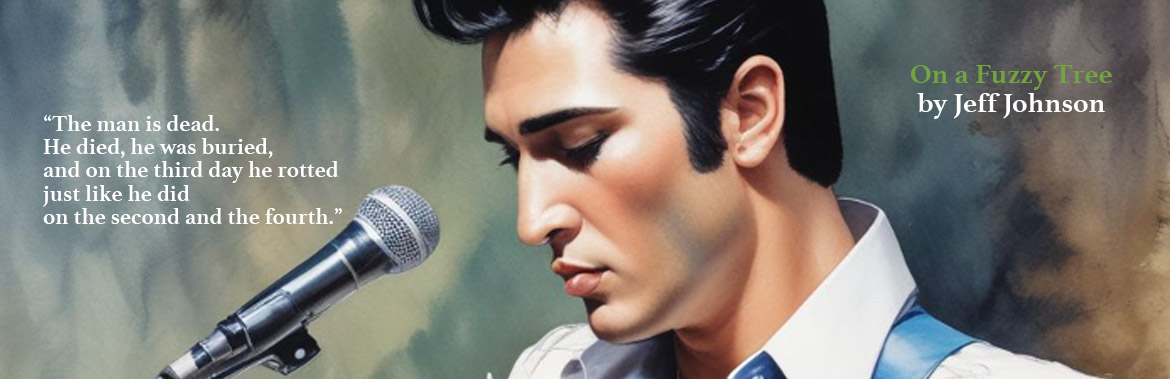
Re your recent Elvis Presley section: The man is dead. He died, he was buried, and on the third day he rotted just like he did on the second and the fourth. I am appalled at the number of people, especially journalists, who want to promulgate these alleged sightings into some kind of quasi-religious phenomenon. Haven’t you got anything better to do? Have you no shame? I suppose next you’ll dredge up the old junior high school tale that JFK’s brain is being kept alive in a jar of chemicals in the basement of the White House. Gods die too, ladies and gentlemen. But I’ve got news for you—life goes on. There are better things to do with your time. Love your family. Eat your vegetables. Pick up after yourself. Shut up and listen for a change.
I’m raving here, he thinks, staring at the screen of his computer. He zaps the letter from memory and powers down. It’s bedtime. Stepping onto the narrow deck of his townhouse, he looks up at what he once might have called the myriad bright sentinels of Morpheus, locates the Big Dipper, which is the only constellation he recognizes, and begins to sing to himself the only Elvis song he knows by heart:
Well, bless-uh my soul, what’s-uh wrong with me?
I’m itchin’ like a ma-hun onna fuzzy tree.
My friends say I’m actin’ wild as a bug,
I’m in love—uh! I’m all shook up…
What the hell is a fuzzy tree, he wonders for the umpteenth time, inwardly smiling at the image. It’s cold on the deck. He knows he should go inside, turn down the thermostat, check to make sure the kids are covered up and breathing, brush and floss and slip into bed without waking his wife, who also had a rough day at the office. He shivers and crosses his arms tightly over his chest and leans back against the railing. He’s knows it’s not a good idea to stay out here too long on a night like this, not when he’s in this kind of a mood. He mustn’t pay attention to the sky and the night sounds. It will only get him thinking about things that can never be.
Subscribers can read all our publications by logging in. |
___________________________________
Jeff Johnson’s work has appeared in The Iowa Review, Intro, Menominee Review, and other journals. He holds an MFA in fiction from the Iowa Writers Workshop and has won awards for short stories, poetry, essays, and journalism. He was for many years the editor of Minnesota Monthly magazine, where he founded the Tamarack Awards fiction competition. He is currently at work on a novel, as well as a fictional memoir of Donald Trump in limerick form. He lives in Minneapolis with his family and their cat, Magic.
Read More: A brief Q&A with Jeff Johnson