
Read More: A brief Q&A with Steven Rea
Magic Town
There’s a rainbow over the old city
and the winter trees
are coated in crystalline gloss
and crystalline gloss is one of those phrases
a poetry teacher would throw
the book at you for, like a Donovan song from the 1960s
and across the avenues
in the high towers with the architectural
elements some people detest and others
walk under unperturbed, two
backpackers from Norway (she’s got
a watch cap with the flag) ambulate
with interest, passing an electronic sign:
LOCAL 7-ELEVEN SELLS POWERBALL WINNER
so somebody is feeling happy
right now, and somebody is feeling happy
tomorrow, maybe.
It’s a magic town, good news and bad news
falling from the sky like parachutists
just before they pull the ripcords
that they’re counting on, counting on.

River Song
An old red bridge spans the river,
the river bending like a crooked man
straightening again as it flows past a garden
with tickseed on its banks
then out from town it goes,
by a field where a woman
and a man dance like happy drunkards
and some distance further two girls throw rocks […]
Subscribers can read the full version by logging in. |

Heart-Shaped Hole
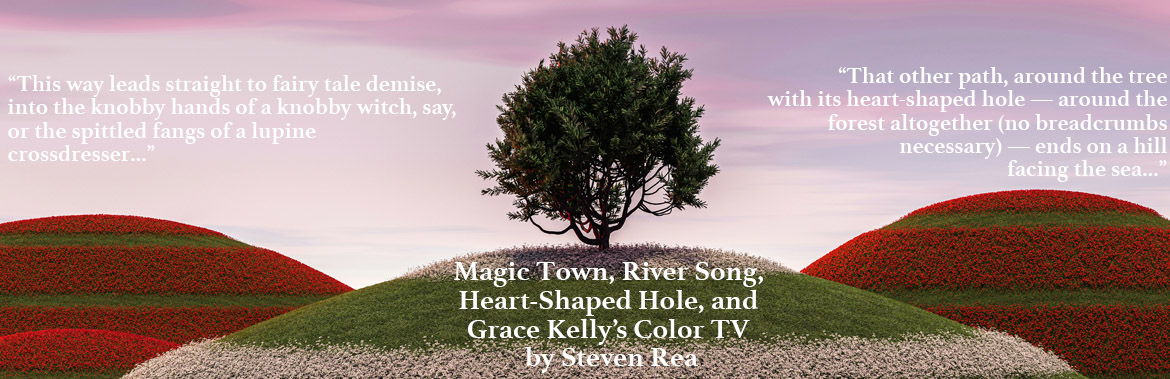
This way leads straight to fairy tale demise,
into the knobby hands of a knobby witch, say,
or the spittled fangs of a lupine
crossdresser. […]
Subscribers can read the full version by logging in. |
Grace Kelly’s Color TV
Grace Kelly gave us her color TV,
it was April, 1961, she and little Caroline and
little Albert were staying at the Stanhope, doing
the things an Oscar-winning-actress-turned-princess does
when dropping into New York.
RCA got wind of the royal visit and had a truck
pull up at the hotel on Fifth Avenue, unloading
The Swarthmore, a Danish Modern console
with remote control and “the powerfu
New Vista tuner.” A gift, and priceless
publicity for the company that brought the
dot sequential color system to the world.
But there wasn’t any color transmission yet
in Monaco (or France) — there wouldn’t be until 1967 —
so when it came time for Princess Grace, her four year-old
and her three-year-old and their nanny to head back across
the Atlantic to the palace on the hill,
the star of Rear Window and The Country
Girl asked the manager of the hotel, my father,
if he would like to have the mahogany-finished TV.
He would, he said, ratcheting up his Continental
charm, and ordering John the elevator man to wheel
the television to our apartment on the second floor.
And so I watched The Crimson Pirate on Million Dollar
Movie in vibrant crimson and The Wizard of Oz
in glinting emerald and I remember The Bride
of Frankenstein, which was in black and white,
of course, but Elsa Lanchester’s dagger fingernails,
her shocked tower of electric hair, seared into my memory
like a Technicolor dream. […]
Subscribers can read the full version by logging in. |
___________________________________
Steven Rea is the author of the archival photography books “The Hollywood Book Club,” “Hollywood Cafe” and “Hollywood Rides a Bike.” He produces the website ridesabike.com. For many years he was the film critic at The Philadelphia Inquirer. His poems have appeared in New York Quarterly, The Paris Review, Rolling Stone, The Seneca Review and other publications. He lives in Maine.
Read More: A brief Q&A with Steven Rea