
Read More: A brief Q&A with David L. Updike
And there came out of the smoke locusts upon the earth:
and unto them was given power,
as the scorpions of the earth have power.
—Revelation 9:3
On the third day he came to the edge of a wide, shallow river. The water rushed over the rocks, rattling them like old bones. Out near the middle a large mass rolled end over end, making its way clumsily downstream. At first, Peter thought it might be a tree trunk, but then a different sort of limb broke the surface and he realized it was the carcass of a large animal, perhaps a steer, or what was left of one. Must be an active ranch somewhere upstream. So much for refilling his water jug. He would still have to cross, though.
But first, rest.
He found a small patch of clear sand amid the jutting rocks and sat down, letting the weight of his backpack pull him to the ground. He stretched out his legs in front of him, taking note that the exposed flesh around his ankles was turning an interesting shade of purple. Something to investigate later.
Across the river, the flat desert terrain continued for some distance before climbing toward a ridge dotted with rough patches of scrub pine, like the back of a mangy dog. Beyond that lay the mountains with their promise of shade, shelter, maybe even potable water. If he could get to them before the locusts got to him.
It had been days since he’d seen a single blood locust—not that you ever saw just one, they always traveled in swarms—but he knew it was only a matter of time. He and Corinne had already had too many encounters, and he’d only survived the last one because they’d gotten to her first.
Corinne. Her final moments had been looping through his head, robbing him of sleep. Corinne flailing on the sand, arms and legs kicking uselessly in the air as hundreds of locusts tore through her clothes, stripped her flesh, ruthlessly and efficiently. It had all happened so quickly. They were out gathering brush for a cooking fire when he heard the first of her screams. By the time he reached the clearing, she was already down and still they kept coming, dropping out of the sky and covering her like a thick, metallic exoskeleton. He took three quick strides toward her before the utter hopelessness of rescue struck him, and then he was running away, in the direction of the abandoned minivan they’d acquired back in Elko. He slid open the back door, dove in, and pulled it shut behind him. Within seconds, locusts began slamming against the windows until they were two, three, four deep. He was sure they’d break right through the glass, devour him as well, but somehow it held. The whole vehicle trembled as Peter lay across the backseat, arms pressed across his chest, fists clenched, awaiting the end. It was only then that he noticed the single locust clinging to his left arm. He watched numbly as it sliced through his flannel shirt, plunged its tiny blades into him, drew blood and tissue into itself.
The shame landed first, even before the pain. They had failed, he had failed, and now Corinne was gone. He told himself then—was telling himself still—that nothing could have saved her. She would have been dead (or worse … not) by the time he reached her. A swarm of blood locusts could take a human being down to a skeleton in minutes. No, he had done the only thing possible, the one that allowed at least one of them to survive. Had their roles been reversed, wouldn’t she have done the same? He decided she would.
Until that moment, everything they’d done since leaving Salt Lake City—foraging for food and supplies from abandoned cars, homes, businesses, and even from the ravaged bodies they’d encountered along the road—had been aimed at their mutual survival. Back home, before the swarms arrived, their relationship had been troubled, spiraling toward an eventual breakup. And then there’d been no time to think about anything but flight and survival, and the road had solidified their bond, as they pooled their resources, their courage, their will to go on. They had a vague plan of reaching the California coast, where his mother lived (if she was even still alive), where things might be better. Mostly they just needed to be headed toward something to get through the day at hand.
A twinge reminded him that he was under attack. He looked down at the shiny, segmented beast burrowing into his arm, almost welcoming the pain. How long would it take this lone assassin to complete its task? Then it plunged deeper, into muscle, and he seized it by its silvery abdomen, pulled it from his flesh, and flung it to the floor. He sat up and began stomping on it, again and again, until it lay scattered in pieces, some of which continued to twitch on the dirt-caked carpet. The thing had left a gaping hole in his shirt and a slightly smaller divot in his arm. He tore off the sleeve at the elbow and wrapped it around the wound, then lay down on the backseat, his arms wrapped around his knees. And somehow, despite the noisy swarm enveloping the vehicle, despite the mounting agony of the wound, despite the fact that he was the worst human being who had ever lived, he had either passed out or fallen asleep.
When he came to, all was quiet. The locusts, having reached some preprogrammed limit of time and energy they’d expend on a single, hard-to-reach target, had moved on in search of other prey. He crawled out of the van and surveyed the damage. They’d stripped the paint and, more devastatingly, devoured the tires down to the rims. Some of them had tried to crawl through grille, hood, and vents and got jammed in place. Most were inert, but he found several that were still struggling to break loose from the tangle of bodies. He picked up a rock and smashed the survivors. It might have felt like revenge, but the gesture brought him no comfort; it was just one more task in the service of survival.
He found their backpacks where they’d left them, leaning untouched against a piñon. The sight of Corinne’s pack propped against his, and of the makeshift firepit they’d built, with its hopeful little teepee of kindling awaiting the touch of a flame, finally brought the weight of loss down upon him, and he sank to his knees in the sand. Their dinner—a can of beans left by a family of four that had suffered the same fate as Corinne—sat unopened on the ground. He didn’t think he could stomach revisiting the site of the attack. There would be little left to bury, anyway. He stood and began taking the stones one by one from the firepit and stacking them into a pyramid on the site where’d they’d last been together. It looked cold and lonely, so he gathered some pink and white yucca flowers to place on top. It would have to do.
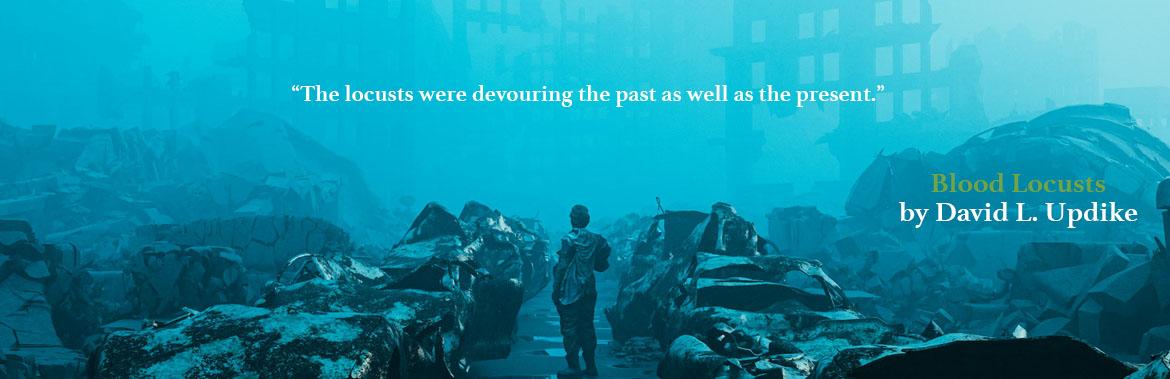
Not for the first time in recent weeks, he wished he could pray, could will himself to believe that there might be someone or something on the receiving end. Instead, he closed his eyes and conjured an image of Corinne as she’d been before the plague uprooted them. He thought of the early days of their relationship, before the tensions set in. He thought of the Corinne who had regaled him with the daily dramas and intrigues of her kindergarten class. Who had, to the consternation of certain neighbors, erected a life-size robot sculpture from old bicycle parts and disassembled furniture in their tiny front yard. He tried to hold onto these images of her, but they seemed impossibly remote, like scenes from a half-remembered film. A flimsy fiction that dissolved in the face of everything that had happened since. The locusts were devouring the past as well as the present.
After a time, he stood, transferred the contents of her pack into his own, and began walking westward.

A noise startled him awake, and Peter bolted upright, reflexively swatting at his face and arms. But it wasn’t locusts, just a black pickup truck rumbling across the desert. It pulled up to the riverbank in a cloud of dust, slid to a halt, and a man climbed out. He was tall and dark-bearded and wore a uniform of sorts, consisting of camo pants and a black long-sleeved nylon pullover to which were pinned a row of makeshift, military-style medals cut from bits of aluminum cans. Peter could only imagine what he’d done to earn those. He had a black baseball cap pulled down over his brow, concealing his eyes in shadow. The gun at his hip was conspicuous but, for now, remained holstered.
“You out here all by yourself?” he said from where he stood, some ten feet away. […]
Subscribers can read the full version by logging in. |
___________________________________
David L. Updike’s work has appeared or is forthcoming in the Chicago Quarterly Journal, Philadelphia Stories, Cleaver, Hobart, Lowestoft Chronicle, Daily Science Fiction, 365 Tomorrows, Journ-E: The Journal of Imaginative Literature, and the anthologies Summer of Sci-Fi and Fantasy, Vol. 2; Flash of the Dead; Dead Girls Walking; and The Dancing Plague: A Collection of Utter Speculation. He lives in Philadelphia, where he runs the publications program at an art museum.
Blood Locusts originally appeared in Summer of Sci-Fi and Fantasy, Vol. 2.
Read More: A brief Q&A with David L. Updike